


Headaches with similar symptoms can have very different underlying mechanisms, and treatment that works well for one type may do little for another. The features below are useful clues rather than a substitute for a formal diagnosis, because headache presentations can overlap.
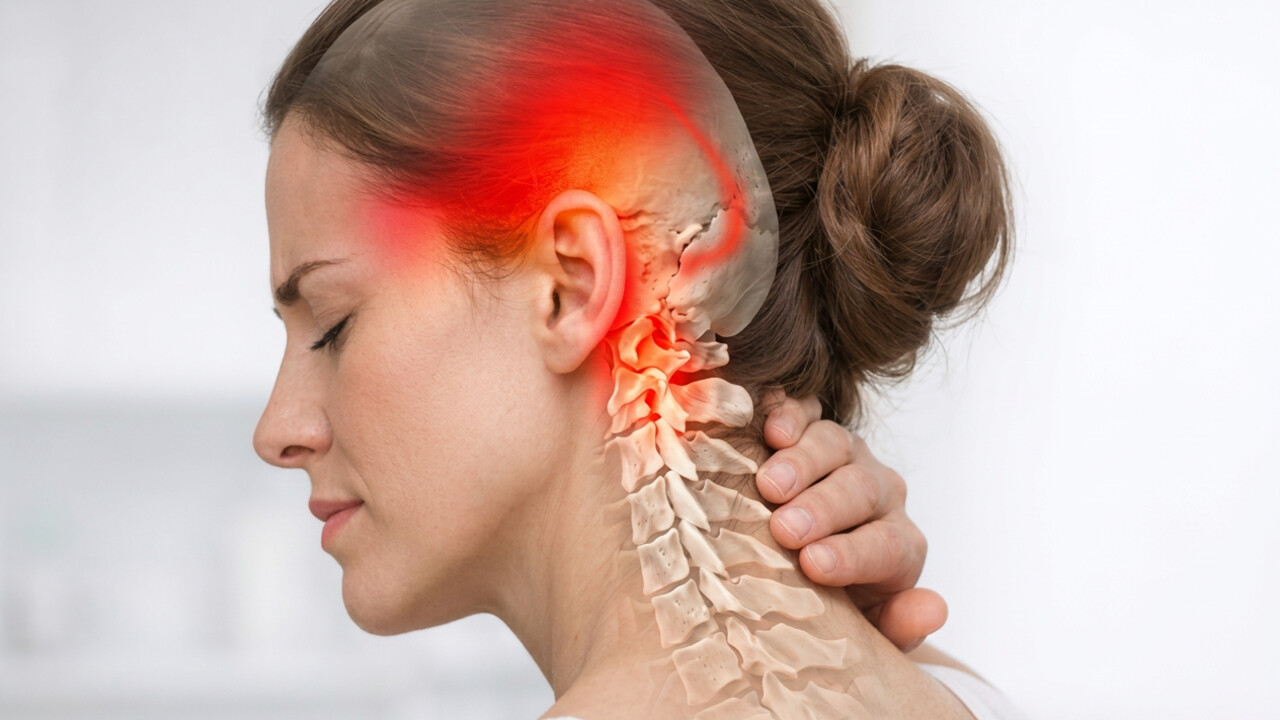
Cervicogenic Headache
- Location: Typically one-sided and often remains on the same side (side-locked)
- Onset: Often follows or is associated with a history of neck injury; can be triggered by specific neck movements or sustained postures
- Triggers: Neck movement, sustained postures, pressure over the upper neck
- Character: Usually mild to moderate and often non-throbbing, although features can overlap with other headache types
- Relationship to the neck: The headache is reproduced or significantly worsened by specific neck movements or provocative testing, and the cervical disorder has evidence of a causal relationship with the headache
- Neck findings: Reduced range of motion, often with a history of neck injury or whiplash
Migraine
- Location: Can be one- or two-sided, sometimes changes sides between episodes
- Character: Often throbbing or pulsing, moderate to severe
- Associated features: Nausea and/or vomiting are common, as are sensitivity to light and sound. Some people experience aura before or during the headache
- Duration: Typically 4 to 72 hours when untreated or unsuccessfully treated
- Triggers: Hormonal changes, sleep disruption, stress, certain foods or alcohol in some individuals, sensory stimuli in some individuals
- Neck findings: Neck pain and stiffness are common alongside migraine, but this does not mean the neck is the primary cause
Tension-Type Headache
- Location: Typically both sides of the head
- Onset: Can be episodic or frequent/chronic; individual episodes may develop gradually
- Character: Pressing or band-like, "tight cap" sensation, not usually worsened by physical activity
- Associated symptoms: Nausea and vomiting are not typical, although either photophobia or phonophobia may sometimes be present
- Triggers: Stress, sustained postures, disrupted sleep
- Neck findings: Neck pain, pericranial tenderness and some cervical musculoskeletal impairments are common, particularly in some people with frequent or chronic tension-type headache, though not everyone with TTH has a significant cervical component
At a Glance
| Feature | Cervicogenic | Migraine | Tension-type |
|---|---|---|---|
| Typical location | One-sided, often side-locked | One- or two-sided | Usually bilateral |
| Quality | Usually non-throbbing | Often pulsating or throbbing | Pressing or tightening |
| Intensity | Mild to moderate | Moderate to severe | Mild to moderate |
| Neck symptoms | Often prominent | Common but not necessarily causal | Common in some patients |
| Neck movement | Often aggravates | May aggravate in some | Variable |
| Nausea | Usually absent or mild | Common | Usually absent |
| Light and sound sensitivity | Less typical | Common | May occur |
| Physical activity | Variable | Often aggravates | Usually does not aggravate |
| Duration | Variable | 4 to 72 hours | 30 minutes to 7 days depending on subtype |
Important: These are typical patterns, not diagnostic rules. Headaches can overlap, and some people experience features of more than one presentation.
Can I Tell Which One I Have?
Not always. Symptoms can provide useful clues, but migraine, tension-type and cervicogenic headaches can overlap. Neck pain, for example, can occur with all three. A proper assessment considers the headache pattern, associated symptoms, triggers and, where appropriate, cervical musculoskeletal findings. A physical examination can help determine whether the neck is contributing, but it should be interpreted alongside the headache history rather than used in isolation.
Why This Matters
Because cervicogenic headache, migraine and tension-type headache can share some symptoms, particularly neck pain, distinguishing between them can be challenging. This is why accurate classification, using headache history alongside an appropriate physical examination where indicated, matters before deciding what treatment is most appropriate.
Headache and temporomandibular disorders can also co-exist, particularly in people with migraine or tension-type headache. If your headaches involve jaw pain, tension or clicking alongside neck symptoms, see our guide to TMJ Dysfunction.
When Should You Seek Medical Assessment?
Seek urgent medical attention for a sudden, extremely severe headache, a headache following significant head trauma, or a headache accompanied by new neurological symptoms, confusion, fever with significant neck stiffness, or other concerning symptoms. New or substantially changing headaches should also be medically assessed. See our full guide's red-flag section for more detail.
Read more in our full guide: Headaches: Types, Symptoms, Causes & Treatment.
Still have questions?
Read quick, direct answers to the questions people most commonly ask about headaches.
Headaches: Frequently Asked QuestionsReferences
- Headache Classification Committee of the International Headache Society. The International Classification of Headache Disorders, 3rd edition. Cephalalgia. 2018;38(1):1–211. doi:10.1177/0333102417738202.
- Racicki S, Gerwin S, Diclaudio S, Reinmann S, Donaldson M. Physical examination tests for screening and diagnosis of cervicogenic headache: a systematic review. Physiother Theory Pract. 2013.
- Anarte-Lazo E, Carvalho GF, Schwarz A, Luedtke K, Falla D. Differentiating migraine, cervicogenic headache and asymptomatic individuals based on physical examination findings: a systematic review and meta-analysis. BMC Musculoskelet Disord. 2021;22(1):755. doi:10.1186/s12891-021-04595-w.
- Liang Z, Galea O, Thomas L, Jull G, Treleaven J. Cervical musculoskeletal impairments in migraine and tension type headache: a systematic review and meta-analysis. Musculoskelet Sci Pract. 2019;42:67–83. doi:10.1016/j.msksp.2019.04.007.
- Pensri C, Liang Z, Treleaven J, Jull G, Thomas L. Cervical musculoskeletal impairments in migraine and tension-type headache and relationship to pain related factors: an updated systematic review and meta-analysis. Musculoskelet Sci Pract. 2025;76:103251. doi:10.1016/j.msksp.2024.103251.
- Bizzarri P, Manfredini D, Koutris M, Bartolini M, Buzzatti L, Bagnoli C, Scafoglieri A. Temporomandibular disorders in migraine and tension-type headache patients: a systematic review with meta-analysis. J Oral Facial Pain Headache. 2024;38(2):11–24.