


Plantar fasciopathy is the most common cause of plantar heel pain, but it isn't the only one. Because the treatment for each of these conditions is different, working out which one you're dealing with matters more than the label "plantar fasciitis" on its own.
A different diagnosis is worth considering when pain is atypical, severe, associated with neurological symptoms, follows a specific trauma, comes with systemic symptoms, or simply isn't responding the way you'd expect.
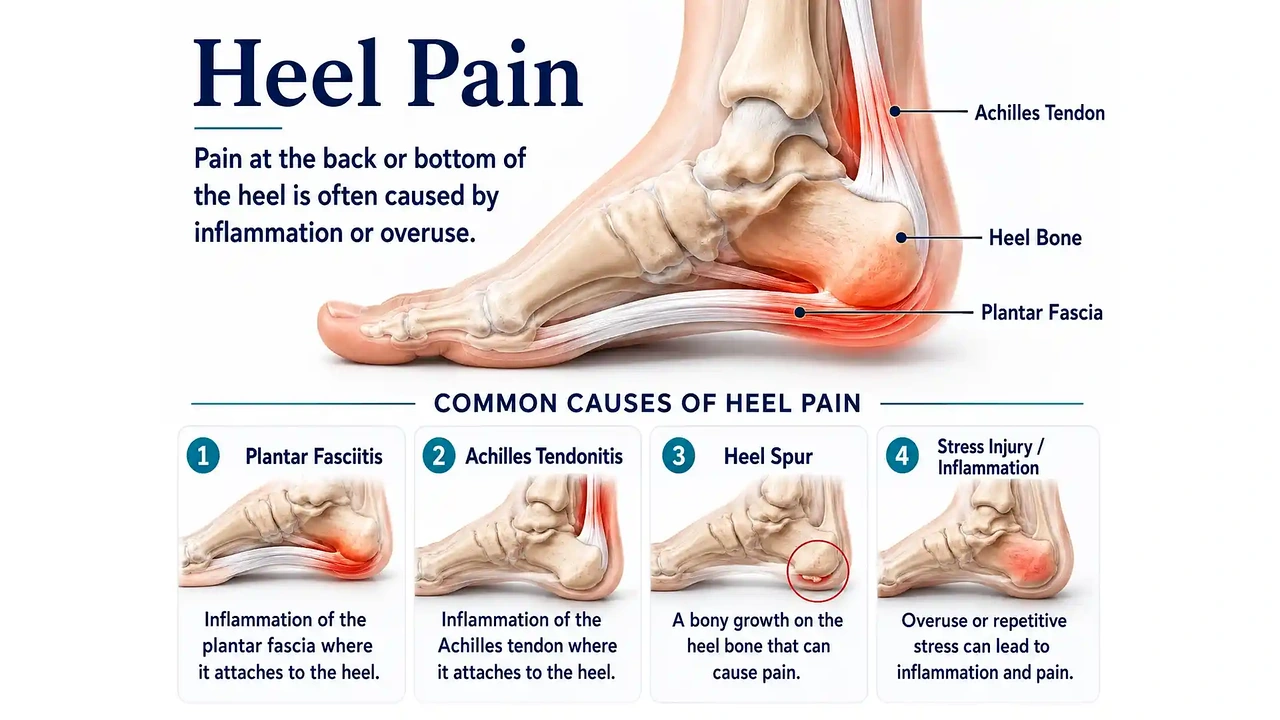
Comparing Common Causes of Heel Pain
Heel pain can come from several different tissues and structures, and the location and behaviour of the pain can provide important clues.
| Condition | Typical pain location | Typical pattern | Distinguishing feature |
|---|---|---|---|
| Plantar fasciopathy | Medial plantar heel | Worse with first steps after rest, eases with initial movement | Tenderness at the medial calcaneal tubercle, with symptoms often reproduced by loading or stretching the plantar fascia |
| Heel fat-pad syndrome | Directly under the centre of the heel | Worse with direct heel-strike, deep bruised sensation | Tender on deep palpation of the central heel pad rather than the medial fascia |
| Nerve irritation or entrapment (e.g. Baxter's nerve) | Medial heel, may radiate | Pain alongside possible burning or altered sensation | Burning, tingling, altered sensation or radiating pain may suggest a neural component |
| Calcaneal stress fracture | Diffuse heel | Pain increases with weight-bearing and impact, often in runners after a load spike | Pain may be reproduced by compression of the calcaneus (calcaneal squeeze test) |
| Plantar fibroma | Mid-arch, along the fascia | Palpable lump, may be tender with pressure | A firm, distinct nodule you can feel within the arch |
| Inflammatory or systemic conditions | Can be bilateral | Persistent, may not follow typical load-related pattern | Accompanied by other systemic symptoms or joint involvement elsewhere |
The evidence base for distinguishing heel fat-pad syndrome from plantar fasciopathy is still limited: a 2022 scoping review found relatively few eligible studies and concluded that, while pain characteristics and behaviour can offer useful clues, robust diagnostic criteria are still lacking.
When to Get It Checked Rather Than Assume
Consider a broader assessment if your heel pain:
- Involves burning, tingling or numbness rather than a purely mechanical ache
- Is present in both heels alongside other joint or systemic symptoms
- Followed a specific injury or sudden traumatic event
- Feels like a distinct, palpable lump rather than diffuse tenderness
- Is associated with significant night pain, unexplained swelling, fever or other unexplained systemic symptoms
- Hasn't improved as expected despite an appropriate period of rehabilitation and activity modification
How Diagnosis Actually Works
Plantar heel pain is usually diagnosed clinically through a detailed history and physical examination. Imaging is not routinely required for typical presentations. Ultrasound or MRI may be useful when the presentation is atypical, the diagnosis is uncertain, symptoms are persistent, or another condition needs to be investigated.
How IP Physio Can Help
As part of every assessment for heel pain, we screen for alternative causes rather than assuming plantar fasciopathy by default. If your presentation doesn't fit the typical pattern, we'll explain what doesn't fit and guide you towards the appropriate next step, whether that's a structured loading programme or a referral for further investigation.
For a full breakdown of plantar fasciopathy itself, including causes, risk factors and what the evidence supports for treatment, read Plantar Fasciitis: Understanding Heel Pain.
References
- Koc TA Jr, Bise CG, Neville C, Carreira D, Martin RL, McDonough CM. Heel Pain – Plantar Fasciitis: Revision 2023. J Orthop Sports Phys Ther. 2023;53(12):CPG1–CPG39. doi:10.2519/jospt.2023.0303.
- Rhim HC, Kwon J, Park J, Borg-Stein J, Tenforde AS. A Systematic Review of Systematic Reviews on the Epidemiology, Evaluation, and Treatment of Plantar Fasciitis. Life (Basel). 2021;11(12):1287. doi:10.3390/life11121287.
- Trojian T, Tucker AK. Plantar fasciitis. Am Fam Physician. 2019;99(12):744–750.
- Chang AH, Rasmussen SZ, Jensen AE, Sørensen T, Rathleff MS. What do we actually know about a common cause of plantar heel pain? A scoping review of heel fat pad syndrome. J Foot Ankle Res. 2022;15:60. doi:10.1186/s13047-022-00568-x.