


Search online and you'll find confident claims about the "single most important cause" of plantar fasciitis, usually tight calves or restricted ankle mobility. The reality, based on current clinical guidance, is more nuanced: plantar heel pain is multifactorial, and several factors contribute in different combinations for different people.
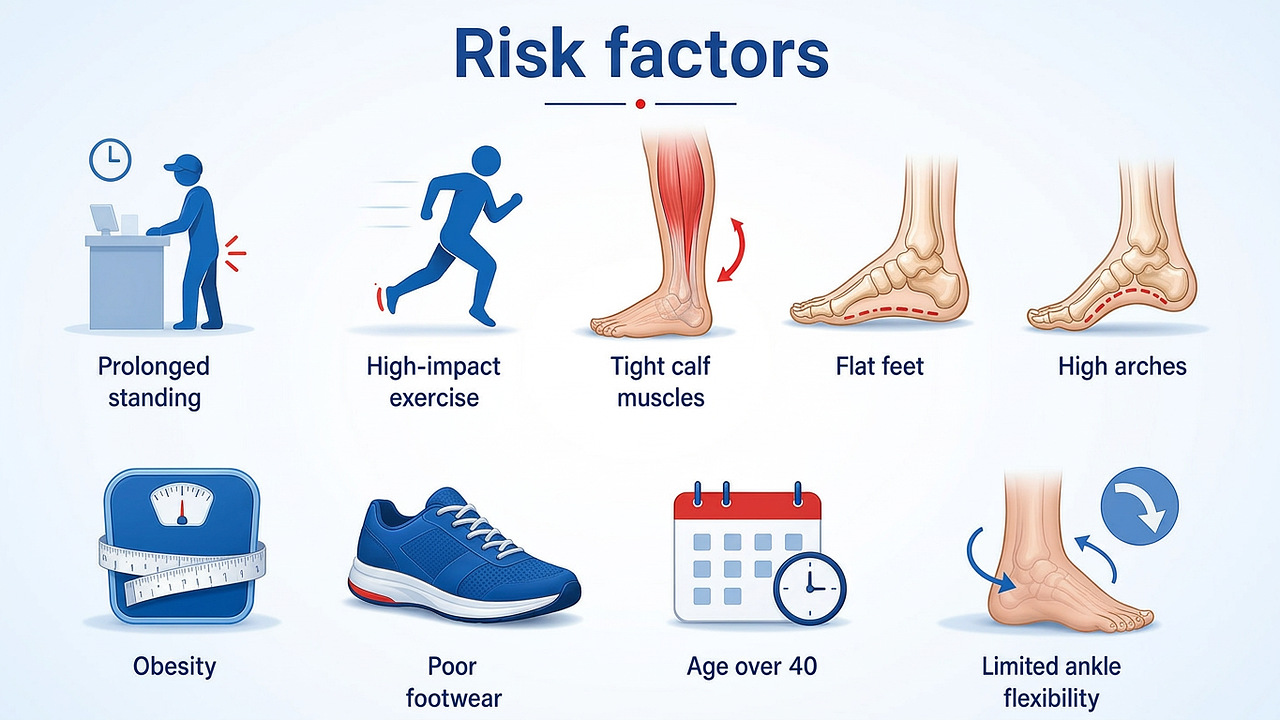
What Current Clinical Practice Guidance Recommends Considering
Current clinical practice guidance recommends clinicians consider the following risk factors for plantar heel pain:
- Limited ankle dorsiflexion
- Higher BMI, particularly in non-athletic individuals
- Running
- Work-related weight-bearing activity, particularly where shock absorption is poor
Ankle Dorsiflexion: Important, Not Singular
Reduced ankle dorsiflexion is one of the better-established risk factors and appears particularly relevant in chronic or recalcitrant cases. Limited dorsiflexion has been found to be common in people with persistent plantar heel pain, which is why it is a useful part of a thorough assessment.
But it is one contributing factor among several, not a single explanation. Broader review evidence describes the overall cause of plantar fasciopathy as multifactorial and not fully understood, with dorsiflexion restriction being particularly relevant in longer-standing, harder-to-resolve cases rather than the primary driver in every presentation.
Bodyweight and Load
Higher BMI is recognised as a risk factor, particularly in people who are not athletic, which may reflect the increased mechanical demands placed on the foot during weight-bearing. This is a contributing factor to assess and address where relevant, not a determinant on its own.
Training and Occupational Load
Running is recognised as a risk factor for plantar heel pain, particularly when overall loading demands are high. In practice, recent changes in training volume, intensity or frequency are useful to assess when symptoms develop. Similarly, prolonged work-related weight-bearing, particularly where shock absorption is poor, is recognised as a risk factor. Both highlight the importance of considering the relationship between the loads placed on the foot and the individual's current capacity to tolerate them.
Muscle Capacity
Muscle capacity may also be relevant to how well someone tolerates higher levels of walking, running or standing. Although reduced calf and foot strength is not established as a primary risk factor in the same way as limited dorsiflexion or higher BMI, assessing strength can help guide rehabilitation and load progression.
Age and Sex
Plantar heel pain is commonly reported in middle age, particularly between approximately 40 and 60 years, and appears to be somewhat more common in women.
Why This Matters for Treatment
None of these factors act in isolation, and no single one explains most cases. A useful assessment looks across dorsiflexion, muscle capacity, bodyweight, training and occupational load together, rather than searching for one "root cause" to fix. This is also why a generic stretching programme may not fully address persistent symptoms on its own: it targets one possible contributor without necessarily addressing the other factors influencing the individual's presentation.
For the full picture on causes, diagnosis and evidence-based treatment, read Plantar Fasciitis: Understanding Heel Pain.
How IP Physio Can Help
We assess ankle dorsiflexion, calf and foot strength, footwear, training or occupational load, and any recent changes that may have triggered your symptoms, then build a plan around the factors most relevant to your presentation rather than a single assumed cause.
References
- Koc TA Jr, Bise CG, Neville C, Carreira D, Martin RL, McDonough CM. Heel Pain – Plantar Fasciitis: Revision 2023. J Orthop Sports Phys Ther. 2023;53(12):CPG1–CPG39. doi:10.2519/jospt.2023.0303.
- Beeson P. Plantar fasciopathy: revisiting the risk factors. Foot Ankle Surg. 2014;20(3):160–165. doi:10.1016/j.fas.2014.03.003.
- Monteagudo M, Martínez de Albornoz P, Gutierrez B, Tabuenca J, Álvarez I. Plantar fasciopathy: A current concepts review. EFORT Open Rev. 2018;3(8):485–493. doi:10.1302/2058-5241.3.170080.
- Riddle DL, Pulisic M, Pidcoe P, Johnson RE. Risk factors for plantar fasciitis: a matched case-control study. J Bone Joint Surg Am. 2003;85(5):872–877. doi:10.2106/00004623-200305000-00015.