


If your headaches are accompanied by jaw pain, morning jaw tightness, clenching, or other jaw symptoms, a temporomandibular disorder (TMD) may be a relevant contributor to your overall symptom pattern.
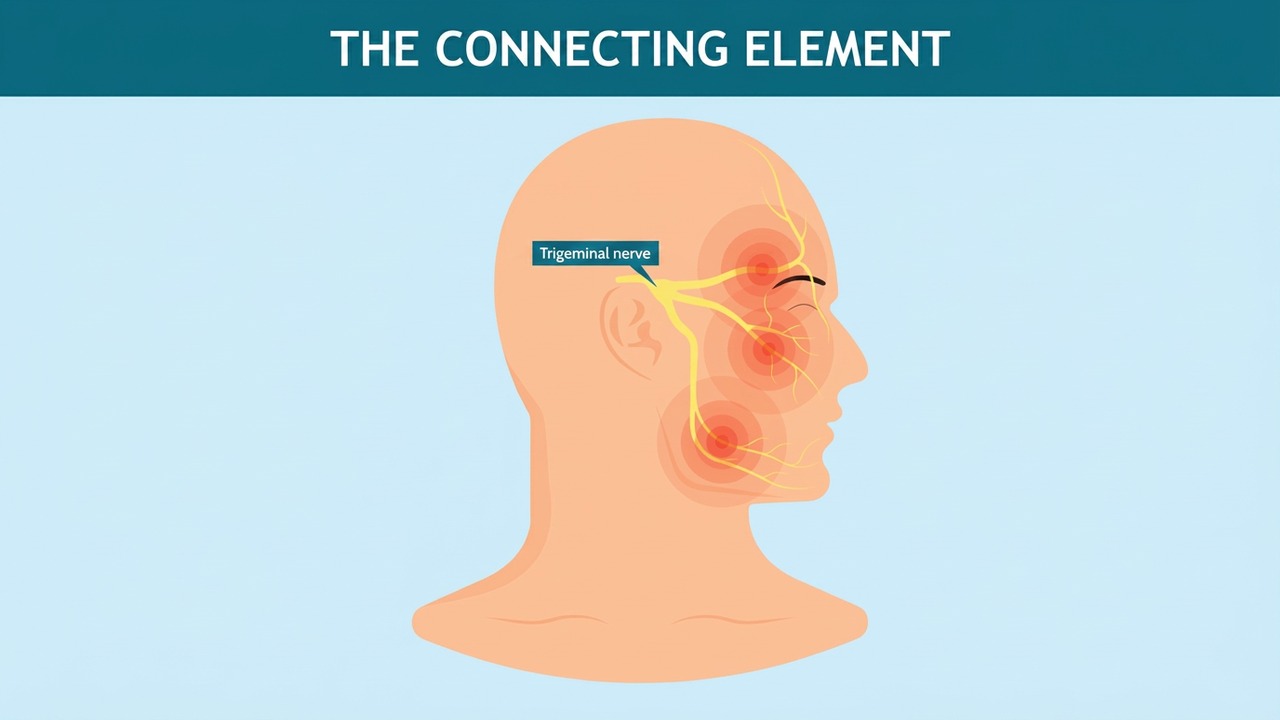
The Connection
The TMJ and the upper cervical spine share overlapping neural pathways through the trigeminal nerve (see: why neck and jaw problems can both cause head pain). This shared neural network provides one mechanism through which pain arising from the jaw and surrounding structures can be perceived in nearby regions, including the temple, face and head.
TMD and headache commonly co-exist for a few reasons:
- Shared muscles: muscles such as the temporalis and masseter can become painful or tender in people with TMD, and tenderness in the head and jaw region can also occur alongside headache.
- Bruxism (teeth grinding or clenching): particularly awake clenching, is associated with TMD and may contribute to jaw muscle pain in some people. Bruxism can occur during sleep or while awake, with clenching sometimes increasing during periods of stress or concentration. Some people also notice morning headaches or jaw symptoms, although the relationship between bruxism and headache is not straightforward.
- Neck and jaw interaction: the jaw and upper cervical region are functionally interconnected, and people with TMD commonly report neck symptoms as well. This does not mean that poor posture causes TMD, but it is one reason both regions may be considered during assessment.
Does TMD Actually Cause Headaches?
Sometimes the jaw may be a relevant contributor, but the relationship is not as simple as "TMD causes headaches." Research consistently finds an association between painful TMD and primary headaches, particularly migraine and tension-type headache. However, the available evidence does not prove that TMD is the cause of headache in every person. Headache and TMD may share biological, muscular and sensory mechanisms, and the relationship can work in both directions.
Signs Your Jaw Might Be Contributing
- Headaches that are worse in the morning or after periods of stress
- Headaches that are reproduced or aggravated by chewing, prolonged talking or jaw movement
- Jaw clicking, popping, or a sensation of catching when opening your mouth
- Tenderness or familiar pain when the jaw or chewing muscles are examined
- Waking with a tight or aching jaw
- A history of teeth grinding or clenching
Clicking or popping on its own is common and does not necessarily mean that treatment is required; it becomes more clinically relevant when associated with pain, locking or functional limitation.
What We Assess
Where relevant, our assessment considers jaw opening and movement, pain during jaw function, TMJ and masticatory muscle symptoms, functional activities such as chewing and talking, and relevant clenching or grinding behaviours. We also assess the cervical spine and consider how the jaw, neck and headache symptoms interact.
Where symptoms suggest a dental, oral-health or other medical issue, such as significant locking, suspected dental pathology, unexplained swelling, trauma, neurological symptoms, or severe or rapidly changing symptoms, we can recommend assessment by an appropriate dental or medical professional.
If Your Jaw Is Contributing, What Can Help?
Treatment depends on what the assessment identifies. Depending on your symptoms, this may include education, jaw exercises, relaxation or motor-control strategies, manual therapy, cervical rehabilitation, and advice around clenching and other aggravating behaviours. For people with both TMD and headache, physiotherapy may improve headache symptoms in some cases, although the current evidence remains limited and variable, and more high-quality research is needed.
Read More
- Temporomandibular Disorders (TMD): What Is It?
- Headaches: Types, Symptoms, Causes & Treatment
- Why Neck and Jaw Problems Can Both Cause Head Pain
Still have questions?
Read quick, direct answers to the questions people most commonly ask about headaches.
Headaches: Frequently Asked QuestionsReferences
- Réus JC, Polmann H, Souza BDM, Flores-Mir C, Bittencourt PCT, Winocur E, Okeson J, De Luca Canto G. Association between primary headache and bruxism: an updated systematic review. J Oral Facial Pain Headache. 2021;35(2):129–138. doi:10.11607/ofph.2745.
- Mortazavi N, Tabatabaei AH, Mohammadi M, Rajabi A. Is bruxism associated with temporomandibular joint disorders? A systematic review and meta-analysis. Evid Based Dent. 2023;24:144. doi:10.1038/s41432-023-00911-6.
- Bizzarri P, Manfredini D, Koutris M, Bartolini M, Buzzatti L, Bagnoli C, Scafoglieri A. Temporomandibular disorders in migraine and tension-type headache patients: a systematic review with meta-analysis. J Oral Facial Pain Headache. 2024;38(2):11–24.
- Demont A, Benaissa L, Pitance L. Efficacy of conservative interventions targeting temporomandibular disorders for adults with headache disorders: a systematic review and meta-analysis. J Oral Rehabil. 2025;52(6):937–948. doi:10.1111/joor.13994.
- Quilghini C, Lefflot J, Buchholtz K. The effectiveness of physiotherapy for chronic headaches in patients with temporomandibular disorders: a systematic review. Front Rehabil Sci. 2025;6:1647927. doi:10.3389/fresc.2025.1647927.
Get in touch with us today if you'd like a musculoskeletal assessment that considers your jaw, neck and headache symptoms together.